


Hello and happy New Year. I hope you’ve all had some time to relax. These few days of rest that many of us are lucky to receive this time of year, paired with a New Year itself, usually give us time to reflect, and that’s where I’ve found my mind going today. So, strap your wings on… this one gets a little philosophical. As always, I love chatting to you in the comments, so please, do drop in. Enjoy!
Regards,
Alia

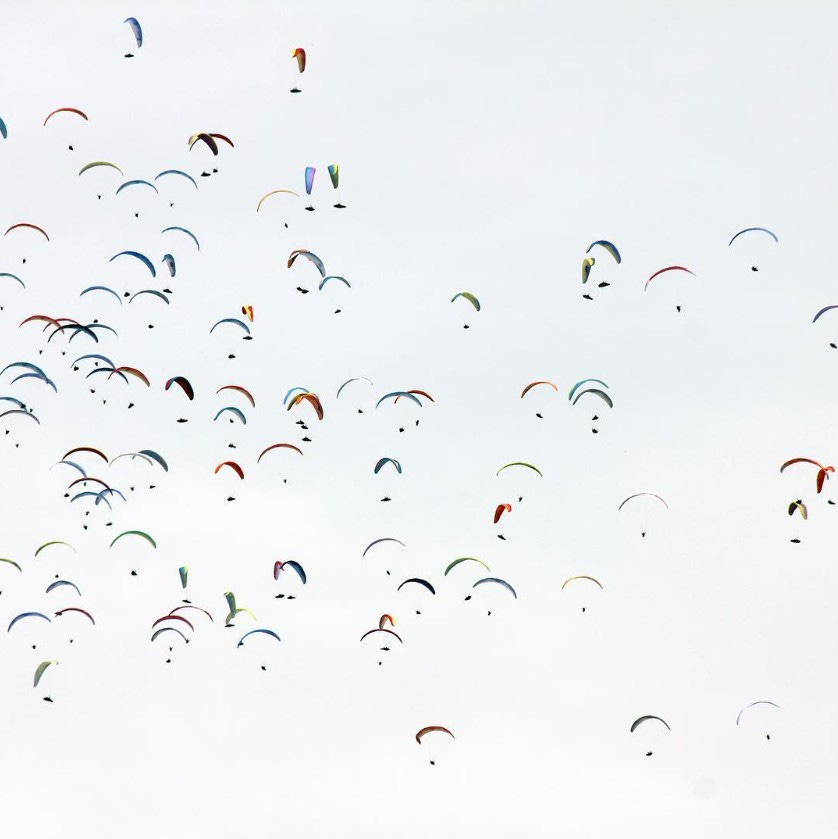
On a summer’s day in the skies above Bright, off the edge of Mystic Mountain and over the river, brightly coloured confetti-like strips ride the breeze; crescents of red and yellow and blue, floating, twisting, spiralling—dangling little bodies beneath on strings. Sometimes they plunge as if sucked into a whirlpool, then, as they draw terrifyingly close to the ground, rebound from an invisible springboard. Tiny heads and hands and legs high above the world, looking beyond our field of view to a horizon layered with ranges that curve out of sight. They can see Mount Kosciuszko from up there.
Mid-January is particularly spectacular—a sky full of sprinkles—100 little paragliders launched together for the National Championships. They ride the thermals up the valley, soaring two kilometres above the ground, and disappear over the hills. With nothing but the heat of the earth and a wing, they stay airborne for hours, traversing up to 100km. I find it frighteningly amazing that someone could trust their life to the wind, that they could suspend themselves above the world in an element they can’t see, an element intrinsically prone to erraticism.
I once turned down an offer to go tandem paragliding. I was curious, but busy. Thought I would go another day. And to be honest, I found the necessity of being strapped tightly to the front of a man, awkward. Oh, and I am probably the most motion-sick person you would ever meet in your life. I do well with my feet on the ground. Even so, I wanted to go, but I told him, no. Said some other time, then garbled some words about how it freaked me out that I couldn’t see what the air was getting up to. He cocked his head to the side and said somewhat cryptically, ‘Yeah, but there are ways,’ and left it at that.
What ways? I wondered. How do you see the invisible? Why aren’t you falling out of the sky all over the place? I was more curious than ever.
There are a lot of paragliders in my area. It comes with the territory. So, while chatting to one recently, I asked him what it was he loved so much about flying and his answer gave me mine. What a fool I had been. Of course there are ways. All I had to do was open my eyes.
He began with the expected cliché—that it was a mental release from life—then paused and thought some more. What he loved most was the problem solving. The aerology. Now I was interested.
“You’re interpreting things you can’t see,” he said. Then he told me about the motion of the trees in the wind, the shape of the ripples as the wind skims the surface of a lake, the movement of the clouds in an updraft, the rise of an eagle; things I marvel at most days of my life. The wind leaves evidence everywhere.
It takes up to 20 years to be able to interpret the atmosphere at a championship-winning level; 10-years to be remotely competitive and three to four years just to be able to complete the set task, he said.
Twenty years, I thought, delighted with how a sport could reveal such an explicit timeframe of how long it takes to understand, that it could provide its own dataset of hermeneutics, that philosophical exploration of understanding. Twenty years to be good at interpreting the wind, that marvellous invisible force.
How long does it take to know the unseen? An emotion? A thought? To interpret that through a smile, the speed at which someone turns their head. The look in their eyes. Their blink, or lack thereof. How long before we know the meaning behind the movement of a hand, the swell of the heat before a storm, the magpie’s stare, the space between bodies? How many years does it take to know when the harvest won’t come, to see the truth, to know a lie?
We understand the world through our own experiences, and that’s a crippling constraint. How do we know when we get it wrong? Unlike paragliding, we don’t exactly fall out of the sky.
The German philosopher Friedrich Schleiermacher (1768-1834) said:
“Misunderstanding occurs as a matter of course, and so understanding must be willed and sought at every point.”
Schleiermacher believed that interpretation is holistic, that it comes in degrees, its angles, its shape, slowly building toward understanding.
Understanding takes time. It’s constant. And we travel alongside one another at our various mismatched stages, misunderstanding—misinterpreting—the other.
To improve our understanding, we must seek, we must experience, we must collate, we must break beyond our horizons. We must live. And in living, we spend our days interpreting the things that can’t be seen, anxiously or otherwise. It’s within these invisible spaces, these seeming voids, that life moves and evolves. It’s within these invisible spaces that we find creation.
How many years does it take to read a silence, a rhythm, a memory? How long before we know a history, a bias, a belief?
How long until we know peace when we’re yet to understand each other?
How long before we learn to trust the wind?
Thank you for Mind Flexing with me. If you enjoyed this essay, please subscribe on Substack or your favourite podcast app, comment, click the ❤️ button, or share it with someone who would appreciate it. I’ll be back in a month. Until then, keep 💪


