


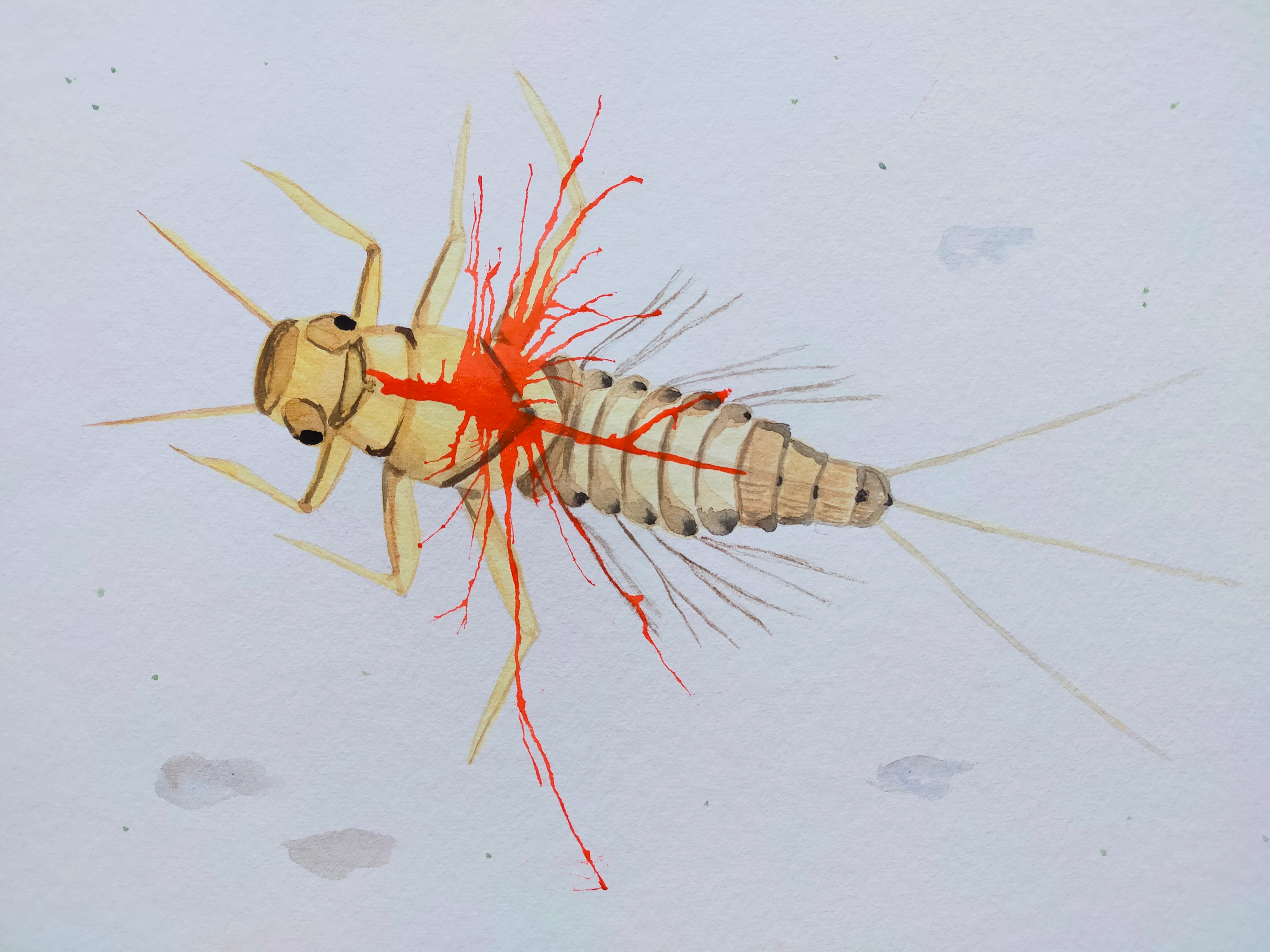
A mayfly nymph the size of a fingernail lays still in the silt of the river. Inside its elongated body, the smallest of hearts beats, though you and I would never hear it. Tiny muscles flex its barely visible gills. We would fail to notice it camouflaged among that which has sunk, but there it exists, its speck of a heart, its muscles, emitting the faintest of electrical signals—a signal 75,000 times smaller than the voltage of a watch battery.
A platypus trawls the river bottom. Its bill sweeps back and forth in the silt, raising a murky cloud that conceals all within. The platypus cannot see the mayfly nymph, at least, not with its eyes. It continues, shaking its head side to side as its bill disturbs the sediment, and as it does a map begins to build inside its mind, a diagram of inanimate objects and of the life between them. Each flex of a mayfly muscle, each flutter of electricity it emits, finds its way to the electroreceptors arranged in rows from the tip of the platypus’s bill to its bridge. A sixth sense that makes the platypus an extremely efficient hunter.
Platypuses can detect electrical currents as low as 20 microvolts per centimetre. A microvolt is one millionth of a volt. Miniscule when you consider a watch battery is 1.5 volts. A typical Australian household power point, 230 volts.
There are usually three points to a power outlet. Two like droopy eyes and a third falling open like the mouth of Edvard Munch’s ‘Scream’. Electricity travels to the power outlet via the live wire, usually the top right socket on the point. An appliance, plugged in, receives this current, allows it to course through the appliance and then out on a neutral wire on the top left. We control this electricity within a circuit. Even so, not all the current may complete its loop via the neutral wire we provide. Small electrical charges may escape, transfer to you via an electric shock, or burst from your appliance with exploding force. So, we find these adventurous currents another way out. We give them a path to the earth, quite literally, a wire that connects our appliances to the dirt.
Here, in the earth, electrical charges neutralise and spread throughout the great conductive mass of the planet. But the story doesn’t end here. The earth is part of one great global electric circuit, where imbalances spectacularly resolve in thunderstorms and lightning strikes. The atmosphere constantly nurses an electric field. We live our lives among it.

My daughters, jumping on the trampoline, laugh as their hair stands on end. Bouncing, their skin rubs against the air while the soles of their feet knead at the spring mat. Electrons transfer to their bodies and are held captive, unable to discharge into the insulating rubber of the trampoline.
I walk toward them, the rubber soles of my shoes creating friction with the ground, but the voltage within me is weaker than theirs—it wants to equalise—and as I reach to lift my youngest, an electric shock surges between us causing us to startle, then laugh.
We walk down to the veggie garden. It is autumn—harvest season. We pick the dead sunflowers for their seeds, pull out the tomatoes, plant brassicas and garlic. We dig our hands deep into the dirt and feel a release. A balance; the energies of our bodies once again neutral with the earth. Scientific studies show a significant reduction in the voltage inside our bodies when in contact with the earth. Some believe this state may reduce inflammation. While the verdict is out, it’s interesting to reflect on the fact that our species once lived in constant contact with the earth, maintaining a continual state of electrical equilibrium. These days we move within synthetic materials, sit inside buildings, and speed along roads in rubber-tyred cars. Perhaps, it’s because of this disconnect that we feel such immense relief when we walk barefoot on the grass, submerge ourselves in the ocean, or hug a tree. As hippyish as it may sound, we really do become one with the earth when we’re grounded.
Thank you for Mind Flexing with me. If you enjoyed this essay, please subscribe on Substack or your favourite podcast app, comment, click the ❤️ button, or share it with someone who would appreciate it. I’ll be back in a month. Until then, keep 💪


